Restoring Hope, Transforming Lives

Education for Engineers and the Leaders that guide them

Every day, medical devices quietly perform miracles. They give sight to those in darkness, restore mobility to the weary, and offer precious moments to families facing uncertain tomorrows. Behind each innovation stands a team dedicated to one profound purpose: easing human suffering. From the simplest bandage to the most sophisticated implant, these technologies don't just impact life—they restore dignity, rekindle hope, and remind us that human ingenuity, at its finest, is an act of compassion. This is why we do what we do.

Our methods have been tested and validated with agencies and regulatory bodies worldwide. We help minimize rework, avoid failed submissions, and keep projects moving.

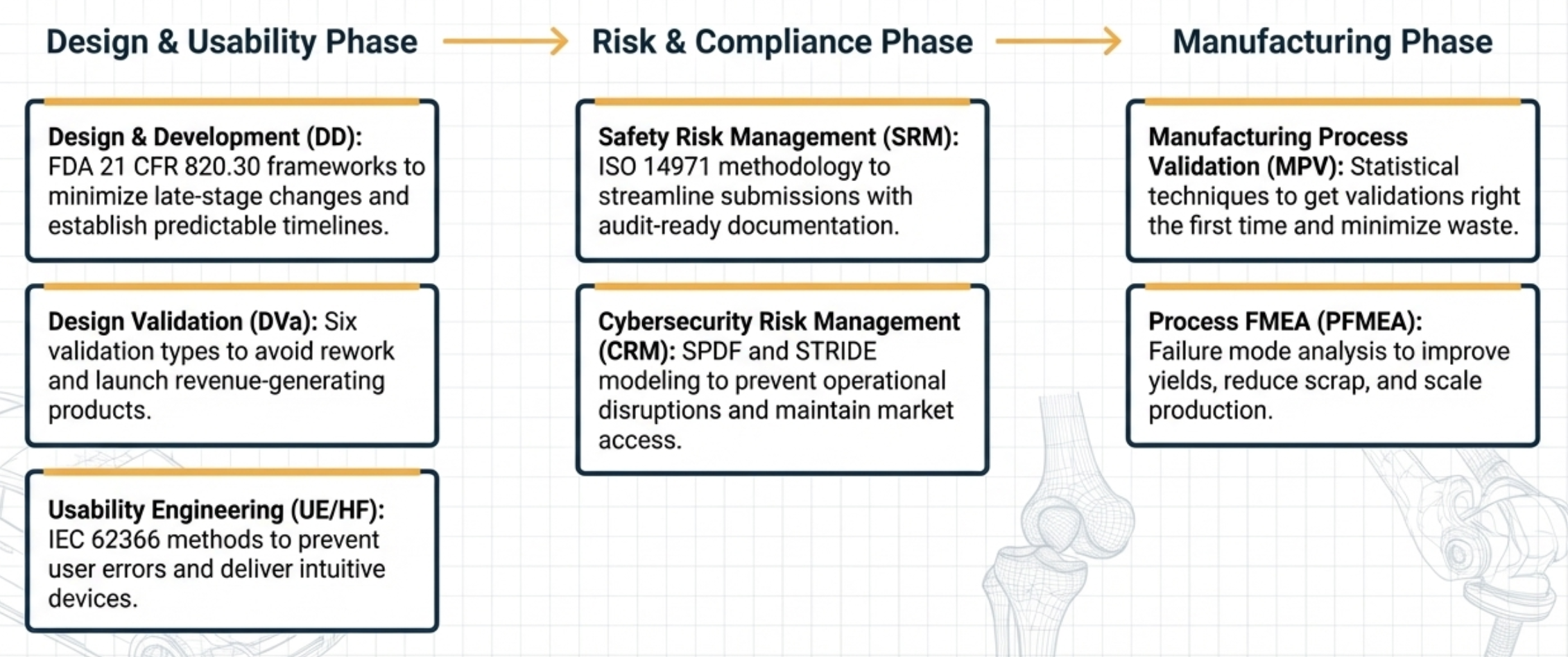
Our education covers all phases of the medical device life cycle


Design & Development (DD)

Organize the chaos of device development - Reduce cost, minimize disruption, and establish predictable timelines for your device launches.

Provides a complete framework for FDA 21 CFR 820.30/ISO 13485 Sect 7.3, guiding the student from the "Voice of Customer" through to Design Transfer, as well as Design and Development File management.

Usability Engineering (UE)

Developing safe User Interfaces (UI), that delight, is a competitive advantage. Poor UI design leads to approximately 36% of device recalls.

The course brings to life IEC 62366-1/FDA Human Factors guidance, teaching use-related risks, critical task identification, and proper execution of formative and summative evaluations to prevent Use Errors.

Design Validation (DVa)

Know that your devices satisfy User Needs (UN), don't guess. Streamline regulatory reviews, avoid costly design rework, and launch devices that users trust and love.

To satisfy ISO 13485:2016 Sect 7.3.7, we cover six critical Design Validation types (Analytical, Usability, Simulated Use, Clinical, Software, and Labeling) to confirm devices meet real-world user needs.

Design Failure Mode and Effects Analysis (DFMEA)

DFMEA is a systematic, team-based method for identifying potential failures in product designs, assessing their severity, occurrence, and detection difficulty, and prioritizing design changes to prevent failures before production.

Provides a complete methodology based on IEC 60812:2018 and AIAG & VDA FMEA Handbook adapted for medical devices which inputs into the ISO 14971:2019 Risk Analysis.

Safety Risk Management (SRM)

Prevent recalls, protect brand reputation, and ensure devices are robust for regulatory submissions.

Focuses on the ISO 14971:2019 methodology, including risk acceptability criteria, benefit-risk evaluation, and the creation of a Risk Management File (RMF).

Cybersecurity Risk Management (CRM)

Avoid submission rejections, prevent operational disruptions, and maintain market access as global security becomes paramount.

Based on FDA Guidance (2026) and AAMI SW96:2023, we address the modern threat landscape by teaching SPDF, STRIDE threat modeling, and vulnerability management to protect patient data and health, as well as your reputation.

Manufacturing Process Validation (MPV)

Reduce manufacturing costs, minimize production disruptions, and engineer predictable manufacturing processes.

Three-stage FDA/ISO 13485 aligned process validation methodology using recognized statistical techniques and leveraging risk-based sample sizes.

Process Failure (PFMEA)

Benefit from sound manufacturing operations, improve production yields, and reduce scrap costs.

Utilizes the 'Bottom-up' approaches of IEC 60812, AIAG, and VDA methodologies to identify process failure modes, understand their effects, and develop actions to reduce their impact.

FAQ

  • Who developed these courses?

    These aren't theoretical lectures; they are the career-work of Dr. John Salvato. With a PhD in engineering and 30+ years of front-line experience—including ISO 13485 Lead Auditor, ISO 14971, and Cybersecurity Risk Management—John doesn’t just teach the regulations; he has defended these exact methods to global regulators. You are learning from an expert who has survived the audits you are preparing for.

  • How do I get support if I get stuck or have a specific project question?

    Unlike "sterile" online platforms, DQS offers a Value Ladder of support. Every course includes direct access to a live expert before and after your training. You get the same "office hours" experience you’d expect from a $10k on-site consultant, ensuring you can bridge the gap between course material and your specific technical challenges.

  • Can I fit this into my schedule?

    Yes. All courses are on demand, so you can complete them around your personal schedule and project deadlines. Course length varies by topic — the material is based on live DQS training that follows a 16 to 20-hour format. Most learners complete a course within 2–4 weeks. DQS gives you a generous 60 days to complete each course, as we understand you are a busy professional interested in career development.

  • Are the courses aligned with current FDA and ISO requirements?

    Yes. All courses align with 21 CFR 820, QMSR, ISO 13485, ISO 14971, IEC 62366-1, SW96, and FDA guidance documents. Content is updated as regulations evolve — you’re learning current requirements, not outdated interpretations. The templates included have been evaluated and accepted by FDA, notified bodies, and regulatory authorities worldwide.

  • Can my whole team take the courses?

    Yes. We offer volume pricing for teams of any size. Each team member gets their own login, access to all course materials and downloadable resources,​ and direct expert support. It’s a cost-effective way to build consistent skills across your engineering, quality, and regulatory teams. For large enough orders, we can customize the course examples and language.

  • Will my team receive a certificate of completion?

    Yes. Each team member receives a certificate documenting the course completed, date, and hours of instruction. These certificates can be used for training records and competency documentation required under ISO 13485 and FDA QMSR — ready for your next audit.